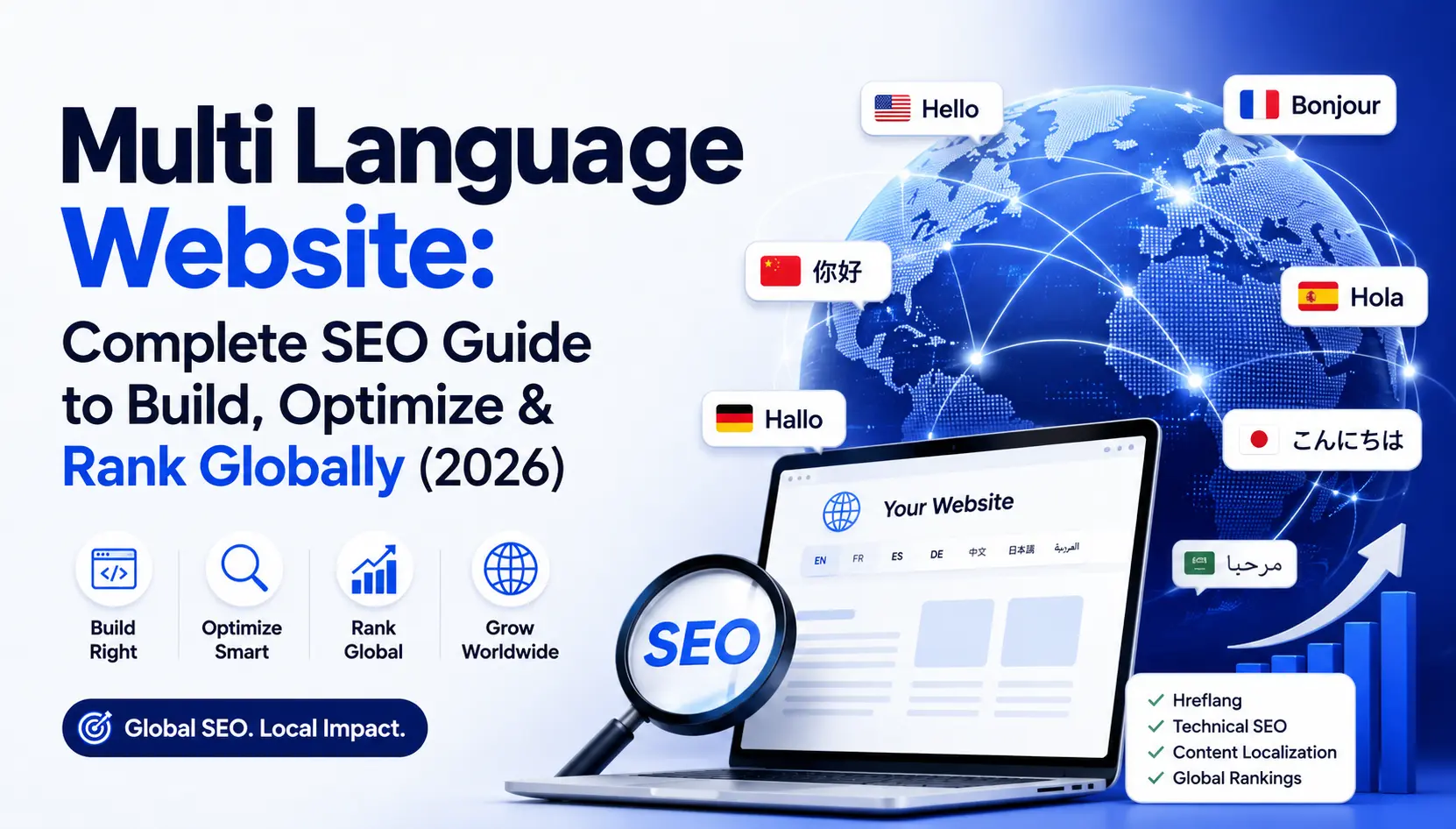
Why Most Websites Fail Globally (And How You Can Win)
You can have the best product, the best design, even strong SEO, but if your website speaks only one language, you’re leaving massive global traffic and revenue on the table. Users trust content in their native language. Google prioritizes localized relevance. And AI search engines are now smarter at detecting intent across regions.
For Learn About: How to Plan a Website Rebuild, Click Here!
In this guide, you’ll learn:
- How to build a multilingual website
- Proven multi language website SEO strategies
- Technical setup (WordPress + HTML)
- Mistakes that kill rankings
- How to turn traffic → leads → clients
What is a Multi Language Website?
A multi language website is a website that provides content in more than one language, allowing users to switch between them easily.
Examples:
- English + Spanish (US market)
- English + Arabic (Middle East)
- English + French + German (EU expansion)
For Learn About: Build a Website With AI in One Day, Click Here!
Why Multi Language Website SEO Matters in 2026
Key Reasons:
- Google ranks localized content higher
- AI search engines prioritize intent + language matching
- Higher conversion rates (up to 70% increase)
- Better global brand trust
For Learn About: Cost to Rebuild a Shopify Store in 2026, Click Here!
Best Practices for Multi Language Websites
1. Use Proper URL Structure
| Structure Type | Example | SEO Impact |
|---|---|---|
| Subdirectory | /en/, /fr/ | ✅ Best |
| Subdomain | fr.domain.com | ⚠️ Moderate |
| ccTLD | .fr, .de | ✅ Strong but expensive |
👉 Recommended: Subdirectories
2. Implement hreflang Tags (Critical)
These tell Google which language version to show.
<link rel=”alternate” hreflang=”en” href=”https://example.com/en/” />
<link rel=”alternate” hreflang=”fr” href=”https://example.com/fr/” />
3. Avoid Auto Translation Only
Bad:
- Google Translate auto content
Good:
- Human + AI optimized translation
4. Local Keyword Research
Example:
- English: “buy shoes online”
- Spanish: “comprar zapatos online”
👉 Intent differs from direct translation ≠ SEO
5. Cultural Localization
Not just language adaptation:
- Currency
- Images
- Tone
- Offers
For Learn About: How to Plan a Website Rebuild, Click Here!
How to Build a Multi Language Website
Option 1: Multi Language Website WordPress (Best for Most Users)
Tools:
- WPML
- Polylang
- TranslatePress
Steps:
- Install plugin
- Add languages
- Translate content
- Set hreflang
- Optimize SEO per language
Option 2: How to Create Multi Language Website in HTML
Basic method:
<select onchange=”changeLanguage(this.value)”>
<option value=”en”>English</option>
<option value=”es”>Spanish</option>
</select>
<script>
function changeLanguage(lang) {
window.location.href = “/” + lang;
}
</script>
👉 But this is NOT SEO-friendly alone. You must:
- Create separate URLs
- Add hreflang
- Index each page
Option 3: Multi Language Website Builder
Popular builders:
- Webflow
- Wix Multilingual
- Shopify Markets
Best for:
- Beginners
- Fast deployment
SEO for Multi Language Website (Advanced Strategy)
1. Separate Content Strategy per Language
Don’t copy-paste:
- Create unique value per region
2. Backlinks per Region
Example:
- French backlinks → French pages
- US backlinks → English pages
3. Technical SEO Checklist
| Task | Status |
|---|---|
| hreflang implemented | ✅ |
| XML sitemap per language | ✅ |
| canonical tags | ✅ |
| fast loading | ✅ |
| mobile optimization | ✅ |
4. AI Search Optimization (2026 Strategy)
To rank in:
- ChatGPT
- Perplexity
- Google AI Overview
👉 Do this:
- Answer questions directly
- Use structured headings
- Provide examples
- Use natural language
Conversion Funnel Strategy
Traffic → Engagement → Lead → Client
Step Flow:
- Blog (SEO traffic)
- Helpful content
- Internal links
- CTA (Upwork / Fiverr)
- Lead conversion
Want a high-converting multi language website that ranks globally?
I help SaaS and businesses build SEO-first multilingual systems.
Common Mistakes to Avoid
- ❌ Using one page with auto translate only
- ❌ Missing hreflang
- ❌ Wrong URL structure
- ❌ No local keyword research
- ❌ Duplicate content
Multi Language Website Example (Real-World Insight)
Good examples:
- Amazon (region-based content)
- Airbnb (localized UX)
- Shopify stores
What they do right:
- Native language experience
- Local SEO
- Fast performance
Simple Infographic: Multi Language SEO Flow
Keyword Research (Local)
↓
Content Creation (Per Language)
↓
Technical Setup (hreflang + URL)
↓
Backlinks (Local Authority)
↓
Ranking + Traffic
↓
Conversion (Localized UX)
FAQ (Optimized for Featured Snippets)
A multi language website in SEO is a site that serves content in multiple languages using proper structure, hreflang tags, and localized keywords to rank in different regions.
Use plugins like WPML or Polylang, create separate pages per language, and implement hreflang tags for SEO optimization.
No. Auto translation alone is not SEO-friendly. You need human-edited or optimized content for proper rankings.
Subdirectories (like /en/, /fr/) are the best balance of SEO, cost, and management.
Users trust content in their native language, which increases engagement and conversion rates significantly.

Conclusion: Build Once, Scale Globally
A multi language website is no longer optional it’s a growth strategy.
If done right, it can:
- Multiply your traffic
- Improve SEO rankings
- Increase conversions globally
But success depends on strategy, not just translation.
For Learn About: Shopify vs WooCommerce, Click Here!
Need Help Planning? If you want to build a multi language website Fix SEO issues Rank globally?
I can help you with a complete SEO + development strategy.