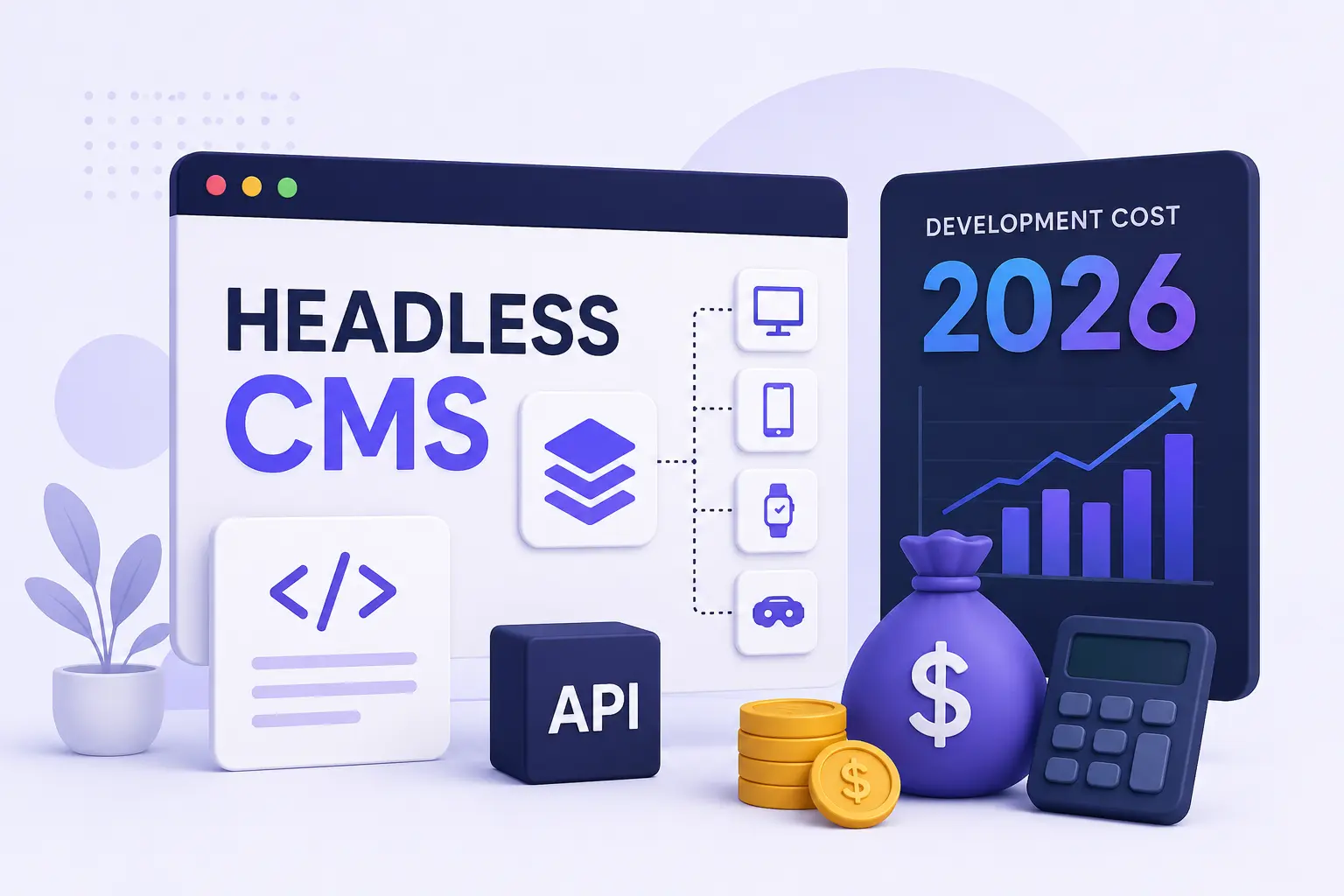
You’ve been told that headless CMS is the future: faster sites, better developer experience, true omnichannel delivery. But the moment you ask how much it actually costs, the answers you find online are either vague (‘it depends’) or wildly inconsistent. That stops here.
This guide is built on real project data. Whether you’re a startup evaluating your first decoupled architecture, a growing e-commerce brand considering migration from WordPress, or an enterprise weighing a multi-site content platform, you’ll find honest numbers, clear breakdowns, and practical advice on where to spend and where to save.
By the end, you’ll know exactly what drives headless CMS development costs in 2026, what platform to choose for your budget, what red flags to watch out for when hiring developers, and how to avoid the expensive mistakes most teams make.
Need a Headless CMS Built? Let’s Talk Budget First.
I’ve delivered 50+ headless CMS projects on Upwork & Fiverr. Get a free, detailed cost estimate tailored to your exact requirements no sales pitch, just honest numbers.
What Is a Headless CMS — And Why Does It Cost More Upfront?
A headless CMS decouples the content backend from the frontend presentation layer. Instead of serving pre-rendered HTML as WordPress does, it stores structured content and delivers it through REST or GraphQL APIs to any frontend a React website, a native iOS app, a digital kiosk, or even an Alexa skill.
That flexibility is powerful. But it also means you’re building and maintaining two separate systems: the CMS backend (where editors live) and the frontend application (what users see). That’s the core reason headless CMS projects cost more than traditional CMS builds.
The Three Layers That Drive Headless CMS Cost
- Content layer: Your headless CMS platform, Sanity, Contentful, Strapi, Payload CMS, etc.
- API layer: The connection logic (REST/GraphQL endpoints, webhooks, authentication, CDN configuration)
- Presentation layer: The frontend framework is typically Next.js, Nuxt.js, Astro, or a native mobile app
Each layer requires specialist skills. A senior Next.js developer commands a different rate than a WordPress theme developer. Add content modelling, CI/CD pipelines, staging environments, and editorial workflows and the investment becomes clear.
For Learn About: Build a Website With AI in One Day, Click Here!
Headless CMS Development Cost by Project Tier (2026 Data)
Based on 500+ projects across agencies and freelance platforms, here are the four primary budget tiers you’ll encounter in 2026:
| Tier | Cost Range | Timeline | What’s Included |
|---|---|---|---|
| Basic / MVP | $10,000 – $30,000 | 4–8 weeks | Sanity/Strapi + Next.js, basic content types, preview |
| Multi-Channel | $30,000 – $70,000 | 8–16 weeks | Multi-language, search, SEO automation, editorial workflows |
| Enterprise | $70,000 – $120,000+ | 5–8 months | Multi-site, personalisation, A/B testing, advanced workflows |
| Custom Platform | $120,000 – $500,000+ | 6–12+ months | Content federation, RBAC, IoT/mobile, legacy migration |
Tier 1: Basic MVP ($10,000 – $30,000)
This covers a single website with a headless CMS backend (commonly Sanity or Strapi), a Next.js frontend, 5–15 content types, basic preview functionality, and Vercel or Netlify hosting. A typical timeline is 4–8 weeks with a 2-person team (one full-stack developer + one designer).
Real-world example: A SaaS startup replacing a static Webflow site with a headless Sanity + Next.js stack to allow their marketing team to publish blog posts, case studies, and landing pages without developer involvement. Budget: $18,000–$24,000.
Tier 2: Multi-Channel Platform ($30,000 – $70,000)
Multi-language support, advanced image optimisation, full-text search (Algolia integration), SEO automation, and editorial approval workflows push costs into this range. Expect 8–16 weeks and a team of 3–4, including a dedicated content architect.
Real-world example: A global e-learning company delivering content to web and iOS/Android apps from a single Contentful CMS. Multiple content editors, localisation into 5 languages, Algolia search. Budget: $52,000.
Tier 3: Enterprise Implementation ($70,000 – $120,000+)
Multi-site management from a single CMS instance, A/B testing integration, personalisation engines, advanced role-based access control (RBAC), and dedicated DevOps for infrastructure management place projects in this tier.
Tier 4: Custom Enterprise Platform ($120,000 – $500,000+)
Content federation across multiple CMS instances, IoT device delivery, full legacy system migration, custom plugin development, and enterprise SLAs. Some large enterprise implementations — particularly in media, finance, or healthcare — exceed $2.6 million when infrastructure and multi-year maintenance contracts are included.
Headless CMS Platform Pricing Compared (2026)
Your platform choice dramatically affects both upfront development cost and ongoing monthly spend. Here’s how the major players price their services in 2026:
| Platform | Free Tier | Mid Tier | Enterprise | Pricing Model |
|---|---|---|---|---|
| Sanity | Free tier | $99/mo (Team) | $949/mo (Business) | Usage-based (API calls + bandwidth) |
| Contentful | 25K records free | ~$300/mo | Custom | Per-seat + usage |
| Strapi (self-hosted) | $0 | $0 (self-host) | Enterprise custom | Open source; pay for infra only |
| Strapi Cloud | — | ~$29/mo | $299/mo+ | Managed SaaS tiers |
| Payload CMS | $0 (open source) | $35/mo (Cloud) | Custom | Per-project cloud or self-hosted |
| Directus | $0 (self-hosted) | $99/mo (Cloud) | Enterprise custom | Open source with cloud option |
| Hygraph | Free tier | $199/mo | Custom | Usage + API calls |
| Prismic | Free tier | $100/mo | Custom | Per-seat pricing |
Pro Tip: The True Cost of “Free” Open Source
Strapi and Payload CMS are free to download and self-host — but you’re trading licence fees for operational burden. Factor in server costs ($50–$500+/mo on AWS/DigitalOcean), DevOps time for updates and security patches, and the ongoing cost of a developer who understands the codebase. For teams without dedicated DevOps, Sanity’s free tier or Strapi Cloud is often cheaper in total cost of ownership.
Full Cost Breakdown: Every Line Item You Need to Budget
Most cost guides focus only on the CMS licence. But a real project budget has eight distinct cost components. Here’s what you should account for:
| Cost Component | Estimated Range | Key Driver |
|---|---|---|
| CMS Platform Licence | $0 – $1,200/mo | Open-source = $0; SaaS varies |
| Frontend Development | $5,000 – $50,000 | Next.js/React complexity + design |
| Backend / API Setup | $3,000 – $20,000 | Custom API routes, auth, webhooks |
| Content Modelling | $1,000 – $8,000 | Schema design, relationships, migrations |
| Hosting (Vercel/Netlify) | $0 – $5,000+/mo | Serverless scales with traffic |
| Integrations (CRM/ERP) | $5,000 – $50,000 | Complexity drives range significantly |
| Content Migration | $2,000 – $15,000 | From WordPress or legacy CMS |
| QA & Testing | $1,500 – $10,000 | API, performance, accessibility |
| Ongoing Maintenance | $1,000 – $10,000/mo | Patches, updates, monitoring |
Developer Hourly Rates by Region (2026)
| Region | Junior Dev | Mid-Level Dev | Senior Dev |
|---|---|---|---|
| North America / Western Europe | $60 – $90/hr | $90 – $150/hr | $150 – $250+/hr |
| Eastern Europe | $25 – $45/hr | $45 – $80/hr | $80 – $120/hr |
| South Asia (Pakistan, India) | $15 – $30/hr | $30 – $60/hr | $60 – $100/hr |
| Southeast Asia / LATAM | $20 – $35/hr | $35 – $65/hr | $65 – $110/hr |
Hire a Vetted Headless CMS Developer — Top-Rated on Fiverr
Need expert Next.js + Sanity/Strapi development without the enterprise price tag? Browse my Fiverr packages for fixed-price headless CMS builds, content modelling, and CMS migrations.
What Factors Most Influence Your Final Headless CMS Cost?
Two projects using the same CMS platform can differ by $40,000 or more. Here’s why:
1. Content Model Complexity
Content modelling — designing the schema of your content types, their fields, relationships, and validation rules — is one of the most underestimated cost drivers. A blog with three content types (Post, Author, Category) is straightforward. A global media platform with 40+ interconnected content types, localisation rules, conditional fields, and bi-directional relationships can add $8,000–$25,000 to a project.
2. Number of Frontend Channels
Building for the web alone is the most cost-effective option. Add an iOS app, Android app, and a digital signage system, and you’re effectively building three frontends that all consume the same CMS API. Each additional channel typically adds $8,000–$20,000 to the total.
3. Third-Party Integrations
Connecting your headless CMS to Salesforce, HubSpot, Shopify, or an ERP system requires custom API work, authentication handling, and data mapping. Simple integrations using existing connectors run $5,000–$15,000. Custom integrations with complex enterprise systems regularly cost $20,000–$50,000.
4. Content Migration
Migrating content from an existing CMS — especially a heavily customised WordPress or Drupal installation — requires data transformation scripts, quality assurance, and often manual editorial clean-up. For sites with 1,000–5,000 pages, expect to budget $5,000–$15,000 for migration alone.
5. Team Composition and Engagement Model
Hiring a specialist agency costs more per hour but delivers faster, more predictable results. Hiring freelancers through Upwork or Fiverr lowers hourly rates but increases project management overhead. Fixed-price projects (available after a paid discovery phase) protect against scope creep. Time-and-material engagements give flexibility but require careful monitoring.
Headless CMS vs Traditional CMS: Full Cost Comparison
The most common question before committing to headless: is it actually worth it over WordPress or Drupal? Here’s an honest side-by-side breakdown:
| Factor | Headless CMS | Traditional CMS (WordPress) |
|---|---|---|
| Initial Cost | $10K – $120K+ | $500 – $10K (WordPress) |
| Platform Licence | $0 – $1,200/mo | $0 – $100/mo (plugins extra) |
| Frontend Flexibility | Any framework (React, Vue, etc.) | Theme-dependent, limited |
| Multi-Channel Delivery | Native (web, app, IoT, AR) | Requires plugins/workarounds |
| Performance (Core Web Vitals) | Excellent (static/ISR builds) | Often poor without optimisation |
| Maintenance Complexity | Higher (2 systems) | Lower (all-in-one) |
| Long-Term Scalability | High | Limited at scale |
| Developer Talent Needed | Senior (React + API) | Junior–Mid (PHP/WordPress) |
The key insight: traditional CMS is cheaper to launch. Headless CMS is cheaper to operate and scale. If your site handles significant traffic, serves multiple channels, or requires high Core Web Vitals scores for SEO, the breakeven point typically arrives within 12–18 months of launch.
Which Headless CMS Is Right for Your Budget?
The “best” headless CMS is always the one that fits your team’s technical capacity, your content requirements, and your budget. Here’s a practical decision framework:
Choose Sanity If…
- You need a fast setup with an excellent editorial experience
- Your team is comfortable with JavaScript and you want the GROQ query language power
- You expect real-time collaboration between content editors
- Budget for platform: Free tier to $99/mo (Team), $949/mo (Business)
Choose Contentful If…
- You’re an enterprise with existing Contentful workflows and compliance requirements
- You need a mature platform with hundreds of marketplace integrations
- Budget: Free tier (25K records), then pricing escalates sharply. Verify current rates
Choose Strapi or Payload If…
- You have DevOps capacity to manage self-hosted infrastructure
- You want zero ongoing licence costs and full data ownership
- You’re building a custom admin UI or white-labelling the CMS for clients
- Budget: $0 licence + $50–$500/mo server costs
Choose Hygraph or Prismic If…
- Your content has complex, deeply nested relational data requirements
- You need a federating layer connecting multiple existing CMSes
5 Proven Ways to Reduce Headless CMS Development Costs
You don’t need to spend $70,000 to get a professional headless CMS implementation. Here’s how experienced teams reduce costs without sacrificing quality:
Start with an MVP, not the full vision
Build core functionality first. Validate with real users before investing in advanced features such as personalisation, A/B testing, or multilingual support. You’ll save 40–60% on initial development.
Use free tiers strategically
Sanity’s free tier includes 100K API requests/month and 10GB bandwidth, enough for most small-to-mid traffic sites. Strapi self-hosted on a $5/month DigitalOcean droplet works for MVPs under significant load.
Choose Vercel or Netlify for frontend hosting
Both offer generous free tiers for Next.js and static sites. No server management, built-in CDN, and instant preview deployments, with zero additional cost until you hit scale.
Invest in a discovery/scoping phase
A paid 1–2 week discovery phase ($2,000–$5,000) produces a detailed technical specification and fixed-price quote. This protects you from scope creep, which is the single most common cause of headless CMS projects running 40–80% over budget.
Hire a specialist, not a generalist
A developer who has delivered 10+ headless CMS projects works faster, makes fewer architectural mistakes, and requires less hand-holding. Paying $80/hr for a specialist often costs less in total than paying $40/hr for a generalist who needs twice as long.
Ongoing Costs: What You Pay After Launch
Development is a one-time investment. But headless CMS projects have recurring costs that many clients under-budget for:
- CMS platform fees: $0 (self-hosted) to $1,200+/month depending on usage and tier
- Frontend hosting (Vercel/Netlify): $0 (free tier) to $400+/month at scale
- Search (Algolia): $0 free tier, then $50–$500+/month based on records and operations
- Image CDN (Cloudinary/imgix): $0–$200+/month depending on transformations and storage
- Maintenance retainer: $1,000–$5,000/month for a dedicated developer on standby
- Annual security audits: $2,000–$10,000 depending on scope
Total ongoing costs for a mid-complexity headless CMS project typically run $2,000–$8,000 per month. Build these numbers into your business case from day one.
Frequently Asked Questions (People Also Ask)
Headless CMS development costs $10,000–$30,000 for a basic MVP, $30,000–$70,000 for a multi-channel platform, and $70,000–$120,000+ for enterprise implementations. The final cost depends on content model complexity, the number of frontend channels, third-party integrations, and the hourly rates of your development team.
Yes — headless CMS costs more upfront. A basic WordPress site runs $500–$10,000, while a comparable headless CMS build starts at $10,000. However, headless CMS delivers significantly better performance, scalability, and long-term cost efficiency. For high-traffic sites or multi-channel content delivery, the total cost of ownership often becomes lower than WordPress within 12–18 months.
Strapi (self-hosted) and Payload CMS are the cheapest in terms of platform licence — both are free and open source. For managed SaaS, Sanity offers the most generous free tier (100K API requests/month, 10GB bandwidth). For small teams and startups, Sanity free + Vercel free tier delivers a complete headless stack at near-zero platform cost.
A basic headless CMS build takes 4–8 weeks. A mid-complexity multi-channel platform takes 8–16 weeks. Enterprise implementations typically run 5–8 months. These timelines assume a clear scope and an experienced development team. Poor content modelling and unclear requirements are the most common causes of timeline overruns.
Yes. Upwork and Fiverr both have skilled headless CMS developers, particularly for Next.js + Sanity/Strapi/Contentful stacks. Look for developers with 10+ completed headless CMS projects, portfolio links showing production sites, and specific experience with your chosen platform. Fixed-price contracts with milestone payments are the safest engagement model for clearly scoped projects.
Conclusion: Spend Smarter, Not More
Headless CMS is not a small investment, but it’s a strategic one. The teams that get the best ROI are those who start lean (MVP first), choose their platform based on actual requirements rather than hype, and hire developers with demonstrated headless experience.
For Learn About: Cost to Rebuild a Shopify Store, Click Here!
To recap what you now know:
- Basic headless CMS builds cost $10,000–$30,000; enterprise implementations range from $70,000–$120,000+
- Platform choice, Sanity, Contentful, Strapi, and Payload significantly affect both upfront and ongoing costs
- Content model complexity, frontend channels, and integration requirements are the three biggest cost drivers
- Self-hosted open source saves licence fees but adds operational overhead
- Ongoing costs ($2,000–$8,000/month) must be built into your business case from the start
If you’re ready to move forward, the smartest next step is a structured discovery phase, not a full development contract. A 1–2 week scoping engagement produces a detailed specification and transparent fixed-price quote that protects both sides.
Hire on Upwork
Top-Rated Headless CMS Developer • 50+ Projects Delivered • Fixed-Price Contracts Available
Order on Fiverr
Fixed-Price Packages • CMS Setup • Migration • Content Modelling Next.js Builds