Introduction: CMS vs Framework — Why This Decision Matters
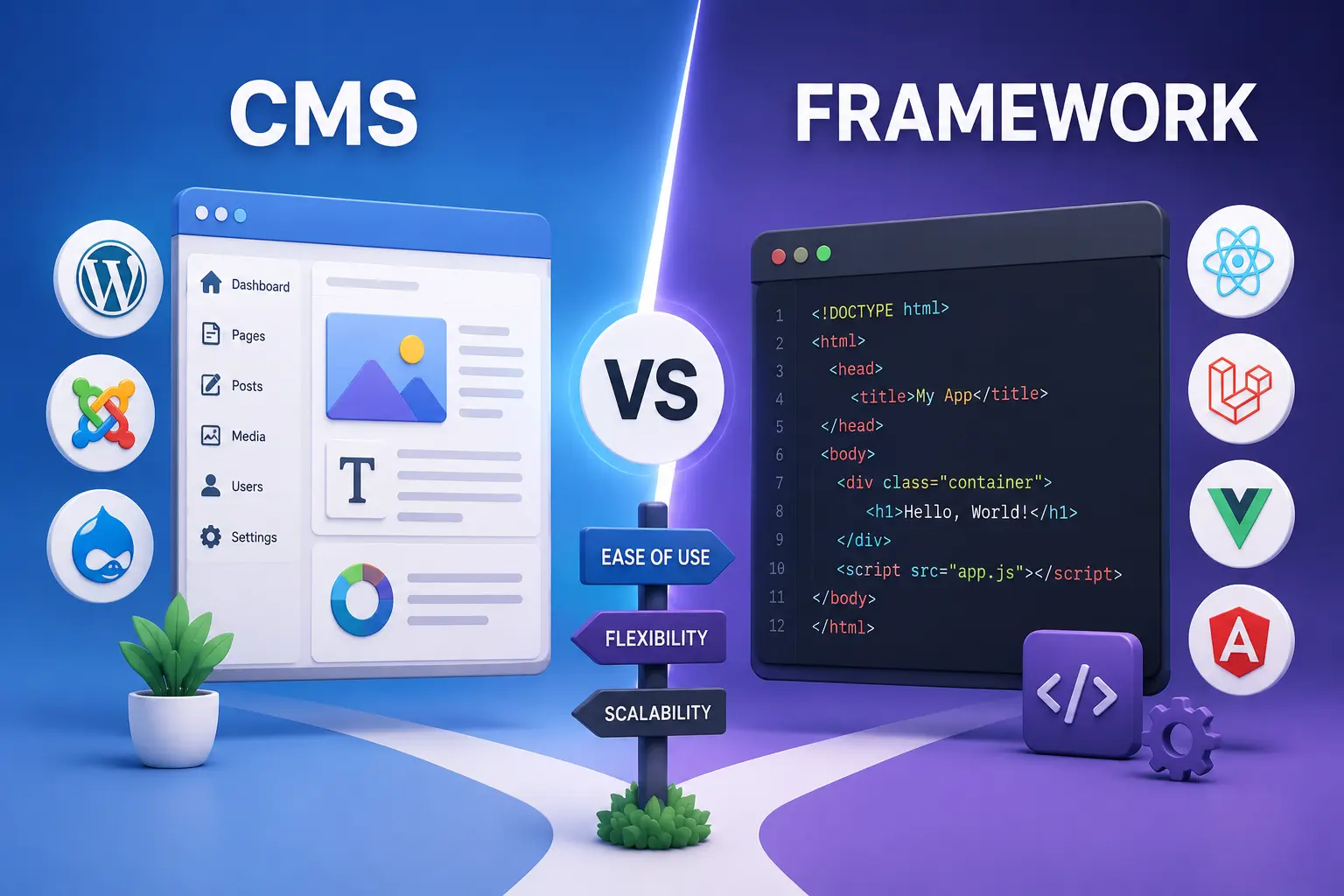
Choosing between a CMS vs framework is one of the most critical decisions in modern web development. It directly impacts your website’s speed, scalability, SEO performance, and long-term maintenance.
Many business owners and even developers struggle with this question: “Should I use a CMS like WordPress or build a custom solution using a web framework?”
In this guide, you’ll learn:
- The real difference between CMS vs web framework
- When to choose each option
- SEO, performance, and scalability comparisons
- Real-world use cases
- Expert recommendations based on 2026 trends
For Learn About: Monolithic vs headless CMS & React framework migration, Click Here!
Need help choosing the right tech stack for your project?
Hire an expert now on Upwork or Fiverr to get a custom recommendation tailored to your business goals.
What is a CMS?
A Content Management System (CMS) is a platform that allows users to create, manage, and publish content without deep coding knowledge.
Popular CMS Examples:
- WordPress
- Shopify
- Joomla
- Drupal
Key Features:
- Pre-built templates
- Plugins and extensions
- Easy content editing
- SEO tools built-in
Real Example:
If you’re running a blog, news site, or small business website, a CMS lets you publish content quickly without hiring developers.
For Learn About: WordPress vs headless, Click Here!
What is a Web Framework?
A web framework is a development tool that provides structure for building applications from scratch.
Popular Frameworks:
- Laravel (PHP)
- Django (Python)
- React (Frontend)
- Node.js (Backend)
Key Features:
- Full control over functionality
- Custom architecture
- Advanced security
- High scalability
Real Example:
If you’re building a SaaS platform or custom application, frameworks give you complete flexibility.
CMS vs Framework: Key Differences
| Feature | CMS | Web Framework |
|---|---|---|
| Ease of Use | Beginner-friendly | Requires coding |
| Development Speed | Fast | Slower |
| Customization | Limited | Unlimited |
| Scalability | Moderate | High |
| Cost | Low | Higher |
| Performance | Moderate | Optimized |
| Security | Plugin-dependent | Strong control |
CMS vs Web Framework: When to Choose What?
Choose CMS If:
- You want to launch quickly
- You have a limited budget
- Your website is content-focused
- You don’t have a technical team
Choose Framework If:
- You need custom features
- You’re building SaaS or complex apps
- Performance is critical
- You want long-term scalability
CMS vs Framework for SEO (2026 Insights)
CMS SEO Strengths:
- Built-in SEO plugins
- Easy content publishing
- Structured data support
Framework SEO Strengths:
- Custom optimization
- Faster load speed
Expert Insight:
In 2026, Google prioritizes performance + helpful content.
Frameworks win in performance, but CMS wins in content scalability.
Best strategy:
Use CMS for content-heavy sites + Framework for product-driven platforms
Want a high-performing website that ranks on Google and converts users?
Hire me on Upwork or Fiverr for SEO + development strategy tailored to your business.
Real-World Use Cases
Case 1: Blog or News Website
Best Choice: CMS (WordPress)
Reason: Fast publishing + SEO tools
Case 2: E-commerce Store
Best Choice: CMS (Shopify/WooCommerce)
Reason: Built-in payment + product management
Case 3: SaaS Platform
👉 Best Choice: Framework (Laravel/Django)
Reason: Custom logic + scalability
Case 4: Enterprise Application
Best Choice: Framework
Reason: Security + performance
For Learn About: Website technology planning, Click Here!
Performance Comparison
| Metric | CMS | Framework |
|---|---|---|
| Page Speed | Medium | High |
| Core Web Vitals | Moderate | Excellent |
| Server Load | Higher | Optimized |
| Custom Optimization | Limited | Full |
Security Comparison
- CMS relies heavily on plugins → higher risk if unmanaged
- Framework offers custom security layers → more control
Expert Tip:
A poorly maintained CMS is riskier than a well-built framework.
Visual Infographic
CMS
✔ Easy
✔ Fast
✔ Affordable
❌ Limited flexibility
Framework
✔ Powerful
✔ Scalable
✔ Custom
❌ Requires expertise
AI SEO Optimization (2026 Strategy)
To rank in AI Overviews (ChatGPT, Gemini, Perplexity):
- Answer questions directly
- Use structured headings
- Add comparison tables
- Provide real-world examples
- Keep paragraphs short and clear
FAQ
A CMS is ready-to-use software for managing content, while a framework is a tool for building custom applications from scratch.
CMS is easier for SEO beginners due to plugins, but frameworks offer better performance and technical SEO control.
Yes, but customization is limited compared to frameworks. For advanced features, frameworks are better.
CMS is easier for SEO beginners due to plugins, but frameworks offer better performance and technical SEO control.
Avoid CMS if your project requires complex logic, high scalability, or custom workflows.
Conclusion: CMS vs Framework — Final Verdict
There’s no one-size-fits-all answer.
- Choose CMS for speed, simplicity, and content-driven sites
- Choose framework for scalability, performance, and custom applications
The smartest approach in 2026 is hybrid thinking:
Use CMS for content + framework for advanced functionality.
For More Information About: e-commerce technology stack, Click Here!
Ready to build a high-ranking, high-converting website?
I help businesses: Choose the right tech stack, build SEO-optimized websites, scale traffic and conversions