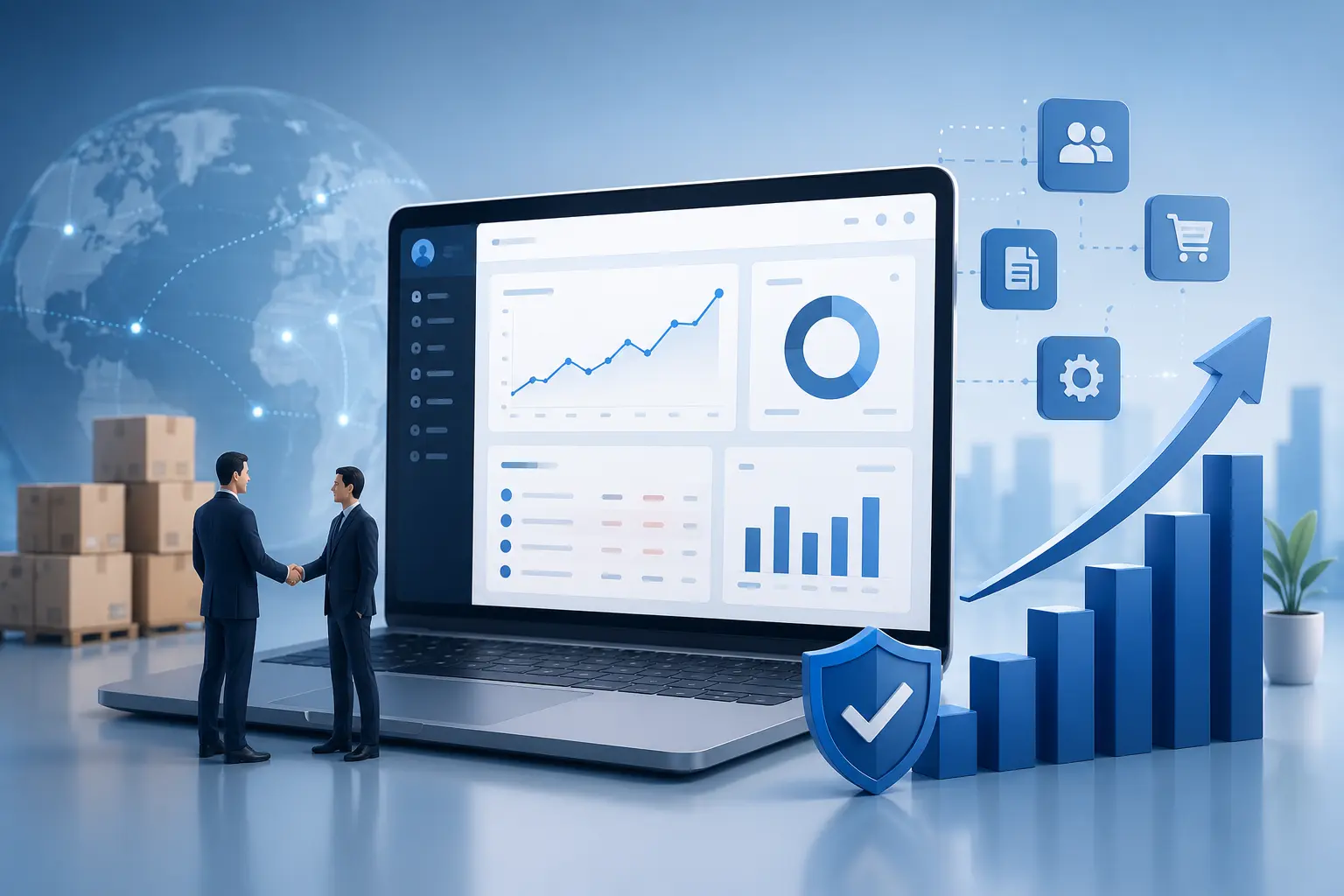
Most businesses outgrow spreadsheets and email chains somewhere around the time they start managing 50+ trade partners. Orders get missed. Pricing tiers create confusion. Customer service drowns in repetitive queries. If that sounds familiar, you are in the right place because a well-built B2B portal fixes exactly these problems.
This guide walks you through everything: what B2B portal development actually involves, what features matter, how much it realistically costs, and how to choose the right B2B web portal development company for your specific situation. Whether you are a manufacturer, distributor, SaaS company, or wholesale brand, the fundamentals here apply to you.
For Learn About: Choose SaaS Development Partner in 2026, Click Here!
Ready to Build Your B2B Portal? Let’s Talk.
I build custom B2B and B2C portals on Upwork and Fiverr — reviewed, trusted, results-driven.
What Is B2B Portal Development?
A B2B portal is a secure, private web platform that businesses use to interact with other businesses, such as trade partners, distributors, resellers, dealers, or wholesale customers. Unlike a standard e-commerce website visible to everyone, a B2B portal is gated, personalised, and built around complex business logic.
B2B web portal development refers to the end-to-end process of designing, building, integrating, and launching this kind of platform. It typically involves custom workflows, role-based access, pricing tiers, order management, and integrations with ERP or CRM systems.
How It Differs from a Standard Website
| Feature | Public Website | B2B Web Portal |
|---|---|---|
| Access | Open to everyone | Login required, role-based |
| Pricing | Fixed / uniform | Customer-specific tiers |
| Orders | Cart + checkout | Bulk ordering, MOQs, approval flows |
| Content | Marketing pages | Personalised dashboards, invoices, catalogues |
| Integrations | Minimal | ERP, CRM, inventory, shipping APIs |
| Users | Any visitor | Registered partners, dealers, resellers |
Why Businesses Invest in B2B Portal Development Services
The shift toward self-service in B2B buying is real and accelerating. A 2024 Gartner report noted that B2B buyers now complete roughly 75% of their purchase journey digitally before speaking to a sales rep. If your buyers are logging into a clunky spreadsheet or emailing orders, you are losing ground to competitors who have already built the infrastructure.
Here is what a well-executed B2B customer portal development project typically delivers:
- Faster order cycles — buyers place, track, and reorder without waiting for a rep
- Reduced support load — self-service means fewer “where is my order” calls
- Better data visibility — you see what your partners are actually doing
- Stronger partner retention — a professional portal signals commitment and trust
- Scalable operations — adding 50 new dealers does not require hiring 5 more account managers
For Learn About: SaaS MVP in 30 Days, Click Here!
Core Features of a Custom B2B Portal
Not every portal needs every feature. But the following are the building blocks that appear in almost every custom B2B portal development project worth the investment.
1. Role-Based Access Control
Different users need different views. A sales manager should not see what a warehouse picker sees. Proper role-based access ensures data security and a clean user experience for each persona — admin, buyer, dealer, reseller, or support agent.
2. Customer-Specific Pricing & Catalogues
This is where B2B logic gets real. Your distributors in Karachi might have a 15% margin; your resellers in London might be on a fixed wholesale price. B2B custom portal development means the system handles this automatically — no manual quoting needed.
3. Bulk Order Management
B2B buyers purchase in quantities, with minimum order quantities (MOQs), volume discounts, and sometimes delayed billing. Your portal needs to handle all of this without breaking the user experience.
4. ERP and CRM Integration
A portal that sits in isolation is nearly useless. Real B2B web portal development connects your front-end ordering system to your back-end ERP (SAP, Oracle, Odoo) and CRM (Salesforce, HubSpot) so that inventory, invoices, and customer records stay in sync.
5. Invoice, Payment & Credit Management
Net-30, Net-60, partial payments, and credit limits for B2B payments are complex. Your portal should reflect your actual payment terms and alert both sides when something is overdue or approaching a credit ceiling.
6. Real-Time Analytics & Reporting
Dashboards showing top-performing products, partner activity, and order trends give you the intelligence to make better business decisions — and give your partners visibility into their own performance.
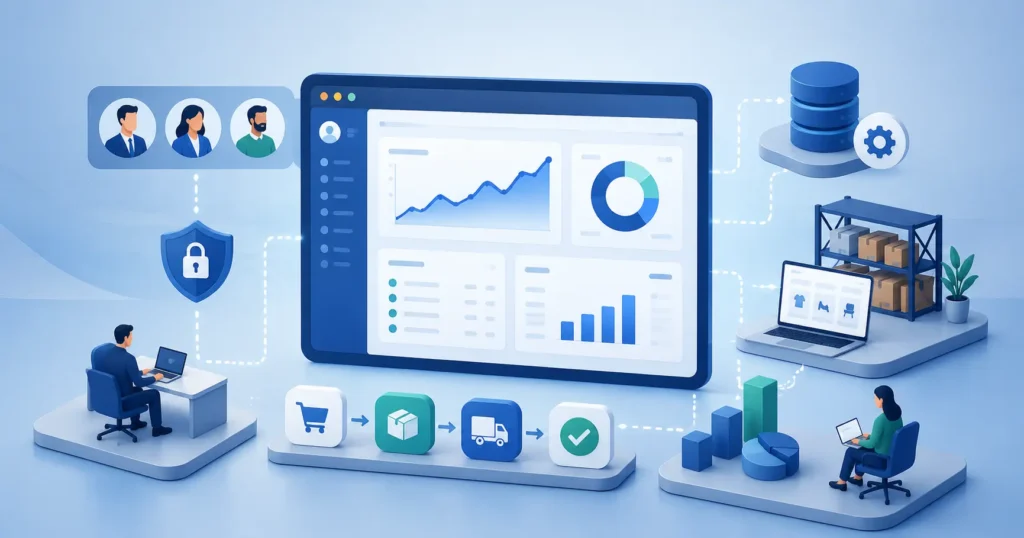
B2B Ecommerce Portal Development: A Specific Use Case
B2B ecommerce portal development is a subset of the broader portal category and it is one of the fastest-growing segments in enterprise software. Platforms like Amazon Business have trained B2B buyers to expect the same ease of consumer shopping, but with the complexity their business requires.
A strong B2B ecommerce portal development service will typically include a product catalogue with advanced filtering, a quote-to-order workflow, saved order lists for repeat purchases, tax-exempt purchasing flows, and multi-currency support for international buyers.
If you are a wholesaler or manufacturer, this is where your portal can become a genuine revenue channel rather than just an operational tool.
B2B and B2C Portal Development: Understanding the Difference
Some businesses need to serve both trade buyers and end consumers from the same platform. This is what B2B and B2C portal development (sometimes written as B2B/B2C portal development) addresses — a dual-mode architecture where the same codebase powers two very different user experiences.
| Dimension | B2B Portal | B2C Portal |
|---|---|---|
| Audience | Registered trade partners | Individual consumers |
| Pricing | Negotiated, tiered | Fixed, promotional |
| Order Volume | Bulk, repeat | Single, varied |
| Payment Terms | Net 30/60, credit | Immediate, card/wallet |
| Support Need | Account manager | Self-service, chatbot |
| Personalisation | By account & tier | By browsing behaviour |
B2B b2c portal development is technically more complex but commercially powerful — especially for brands that sell direct-to-consumer while also running a wholesale business.
B2B White Label Travel Portal Development
The travel sector has its own specialised take on B2B portals. B2B white label travel portal development involves building a bookable travel platform — flights, hotels, transfers, tours — that travel agencies can brand as their own and sell to their clients.
Key components include GDS/API integration (Amadeus, Sabre, Travelport), a markup management system, agent sub-accounts, booking management, and commission reporting. This is a niche but lucrative space for agencies and travel tech startups alike.
How to Choose the Right B2B Web Portal Development Company
The agency or freelancer you choose will make or break your project. Here is a framework that works better than just comparing quotes.
Look for Demonstrated Domain Experience
A B2B web portal development agency that has built supplier portals, dealer networks, or wholesale ordering systems before understands the edge cases — credit limit warnings, approval workflows, tiered pricing exceptions — that trip up generalist developers.
Evaluate Their Integration Track Record
Ask specifically: have they integrated with your ERP or CRM before? B2B web portal developers who have worked with SAP, Odoo, or Salesforce will move significantly faster and make fewer costly mistakes than those learning on your project.
Assess Communication and Project Management
More B2B portal projects fail due to poor communication than poor code. Look for developers who ask good questions during scoping, give honest timeline estimates, and have a clear process for handling change requests.
Check Their Work on Freelance Platforms
If you are working with a freelancer rather than an agency, platforms like Upwork and Fiverr provide verified reviews, job success scores, and portfolio samples — a more transparent signal than a polished agency website alone.
Looking for a Trusted B2B Web Portal Developer?
With verified Upwork and Fiverr profiles, 5-star reviews, and a proven track record in custom B2B portal development — let’s scope your project together.
B2B Portal Development Cost & Timeline: What to Realistically Expect
One of the most searched questions around this topic is simply: how much does it cost? The honest answer is that it depends heavily on complexity, integrations, and who you hire. Here is a realistic breakdown.
| Project Scope | Typical Timeline | Estimated Cost (USD) | Best For |
|---|---|---|---|
| Basic partner portal (no ERP) | 4–8 weeks | $3,000–$8,000 | SMEs, early-stage B2B |
| Mid-range portal + ERP integration | 8–16 weeks | $8,000–$25,000 | Growing manufacturers, distributors |
| Full B2B ecommerce + CRM + ERP | 16–28 weeks | $25,000–$70,000+ | Enterprise, multi-region ops |
| White label travel B2B portal | 12–20 weeks | $15,000–$50,000 | Travel agencies, tour operators |
| B2B/B2C dual-mode platform | 20–32 weeks | $30,000–$100,000+ | Hybrid wholesale + retail brands |
Working with freelance B2B web portal developers through platforms like Upwork can meaningfully reduce cost without sacrificing quality — particularly for mid-range projects where an experienced independent developer will outperform a bloated agency team.
Technology Stack for B2B Web Portal Development
Your technology choices affect maintainability, scalability, and total cost of ownership. Here is what experienced B2B web portal development agencies typically use.
| Layer | Common Technologies | Notes |
|---|---|---|
| Frontend | React.js, Vue.js, Angular | React dominates for complex portals |
| Backend | Node.js, Laravel, Django, .NET | Laravel & Django strong for data-heavy apps |
| Database | PostgreSQL, MySQL, MongoDB | Relational DBs suit structured B2B data |
| ERP Integration | REST APIs, GraphQL, Webhooks | Depends on ERP vendor support |
| Authentication | OAuth 2.0, SAML, JWT | SSO critical for enterprise clients |
| Hosting | AWS, Azure, GCP | Choose based on compliance needs |
| CMS (optional) | Headless CMS (Contentful, Strapi) | SSO is critical for enterprise clients |
Frequently Asked Questions
B2B portal development is the process of building a secure, web-based platform that allows your business to interact with trade partners, resellers, or wholesale buyers in a structured and automated way. You need it when managing partners through email and spreadsheets becomes too slow or error-prone — typically once you have more than 20–30 active trade accounts.
A basic B2B web portal with core features like login, catalogue, and order management typically takes 4 to 8 weeks. More complex portals with ERP integration, custom pricing engines, or dual B2B and B2C functionality can take 16 to 32 weeks. Timeline depends heavily on the complexity of integrations and how quickly your team can provide feedback during development.
A B2B portal is designed for registered business accounts, with features like negotiated pricing, bulk ordering, credit terms, and account manager access. A B2C portal serves individual consumers with fixed prices, immediate checkout, and high-volume self-service. Some platforms support both simultaneously — this is called B2B/B2C portal development.
Look for a B2B portal development company or freelancer who can show past work on similar projects, has experience with your specific ERP or CRM, and uses a transparent project management process. Platforms like Upwork provide verified reviews and project history, making it easier to evaluate candidates objectively before committing.
Yes, especially if you work with experienced freelance B2B web portal developers rather than large agencies. A focused scope — say, a portal for order placement, catalogue browsing, and invoice download — can be built for $3,000 to $8,000. You can then expand features incrementally as your business grows rather than over-building on day one.
Conclusion: Build the Portal Your Partners Actually Want to Use
A B2B portal is not just an IT project — it is a commercial decision that affects how your partners experience doing business with you. Done well, it accelerates orders, reduces operational friction, and signals that you are a serious long-term partner.
The key takeaways from this guide: understand what your partners genuinely need before scoping features, integrate with your existing systems from day one, and choose a developer or B2B web portal development agency with verifiable experience in your domain.
If you are ready to move from planning to building, start with a clear scope document and a developer who asks better questions than you do — that is usually the clearest sign they know what they are doing.
Start Your B2B Portal Project Today
I’m an experienced B2B web portal developer with active profiles on Upwork and Fiverr. Whether you need a simple partner portal or a full B2B ecommerce platform, I’ll scope it honestly and build it properly.